Rookies vs Vets. Who has more upside for the rest of the season?
We checked every rookie and veteran from 2010 to 2025. In the second half of the season, rookies rise more than veterans who were scoring the same, in all 16 seasons.
- Rookies scored 6.1 PPR points a game in Weeks 1 to 8 and 7.1 in Weeks 10 to 17. Veterans went from 8.5 to 8.3.
- It holds up under the fairest test we could run. Against veterans who started at the same level, rookies gain 0.7 points a game more in the second half.
- That held in all 16 seasons, and rookies' share of their team's targets and carries grew too. It is a bigger role, not luck.
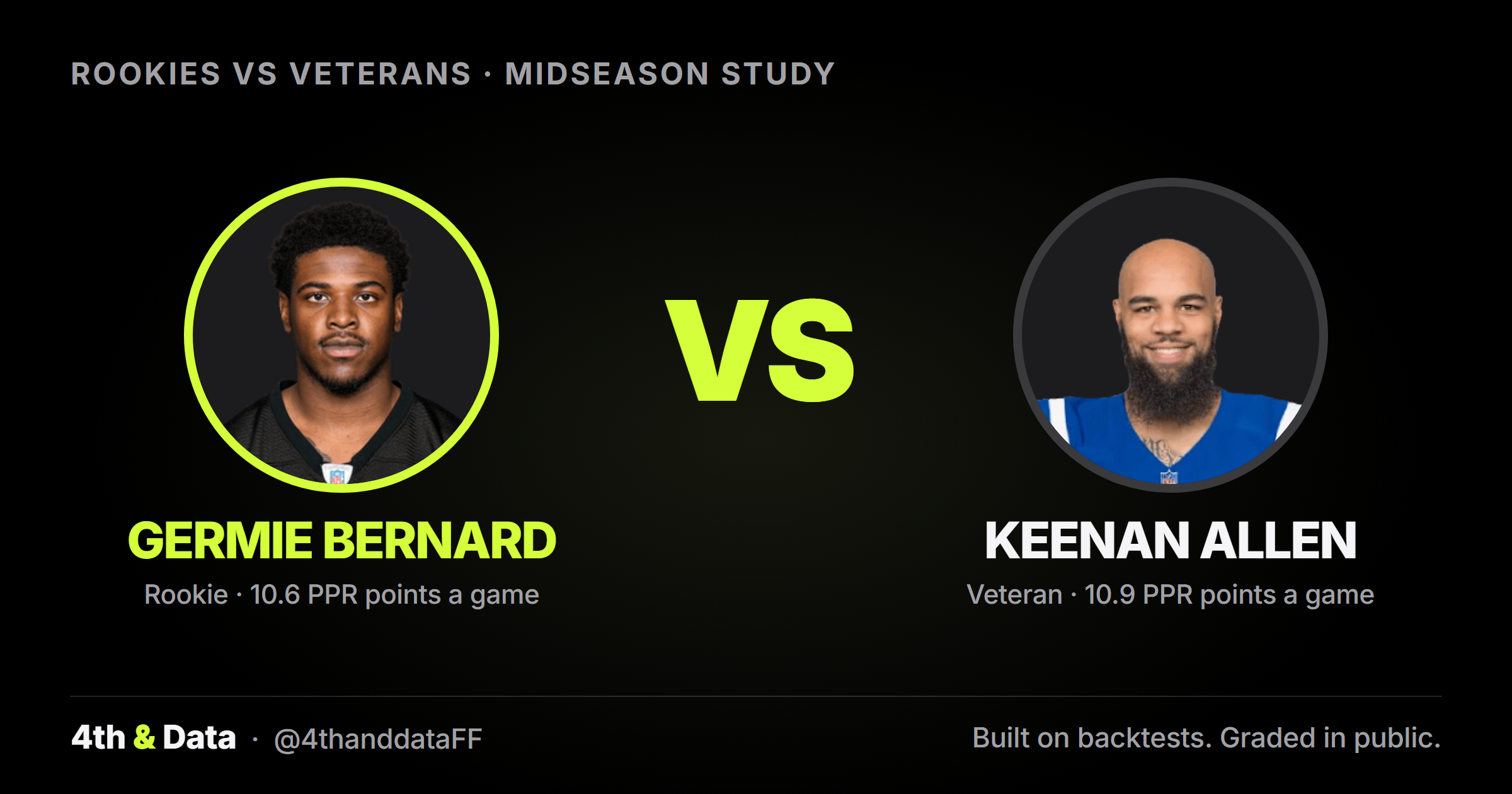
- It is strongest at receiver and running back. The 2026 rookies who fit right now are Carnell Tate and Germie Bernard.
What we tested
We split every season from 2010 to 2025 in two. The first half is Weeks 1 to 8 and the second half is Weeks 10 to 17. We left out Week 9 as the seam, and Week 18, when good teams rest their starters.
A player counts if he played at least 3 games in each half. That leaves 763 rookie seasons and 4,527 veteran seasons at quarterback, running back, receiver and tight end. Scoring is PPR, where every catch is worth a point.
The raw numbers
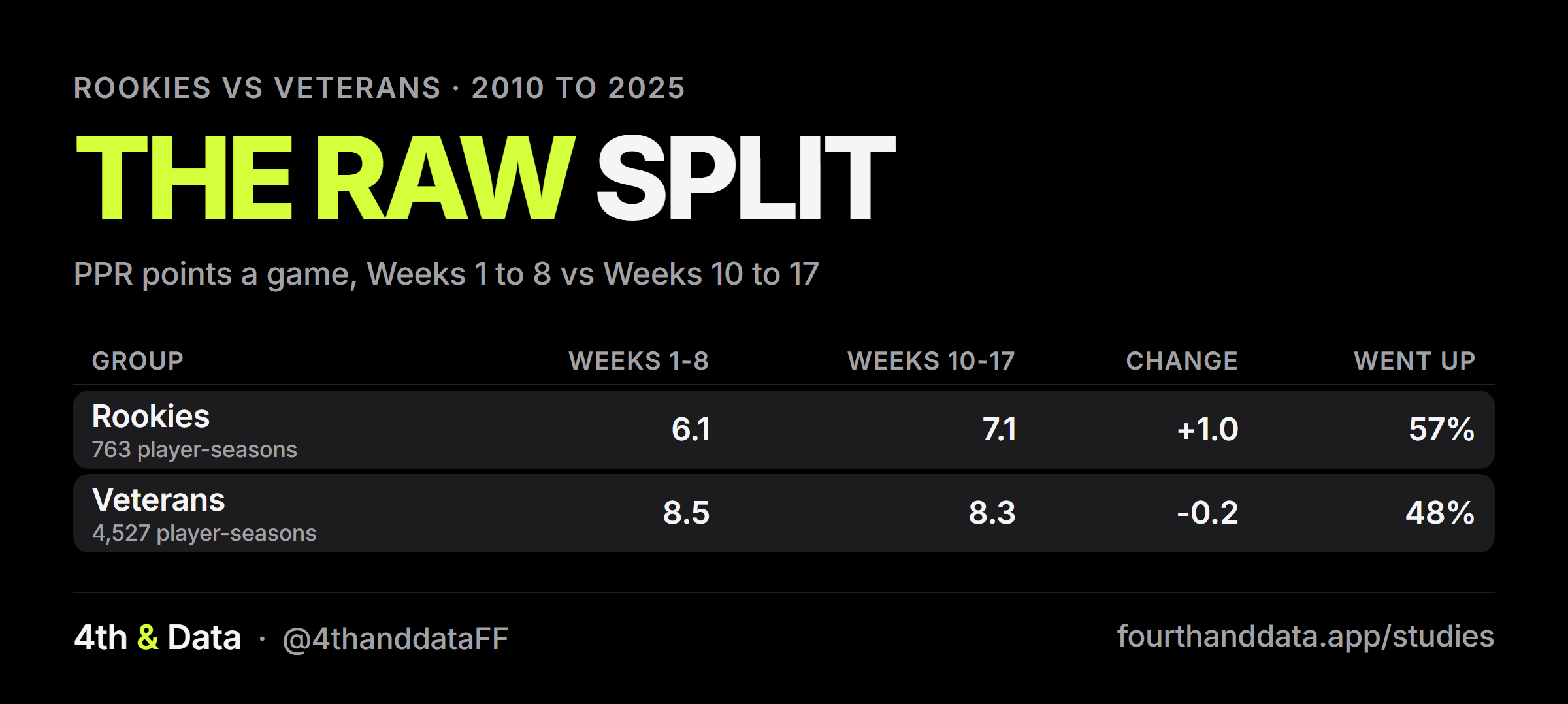
Rookies went from 6.1 points a game to 7.1. Veterans slipped from 8.5 to 8.3. And 57% of rookies scored more in the second half, against 48% of veterans.
That is a 1.2 point gap in favor of rookies. Before calling it, we put it through a tougher test.
The fair test
Rookies start lower. They averaged 6.1 points a game in the first half, veterans 8.5. Any player who starts low tends to bounce back some, rookie or not, because part of a slow start is bad luck that does not repeat. So we had to make sure the rookie edge was not just that bounce.
You can see it in the veterans. Those who scored under 4 points a game in the first half gained 1.2 in the second. Those who scored 20 or more dropped 3.6. That is the bounce, and it is why we compare like with like.
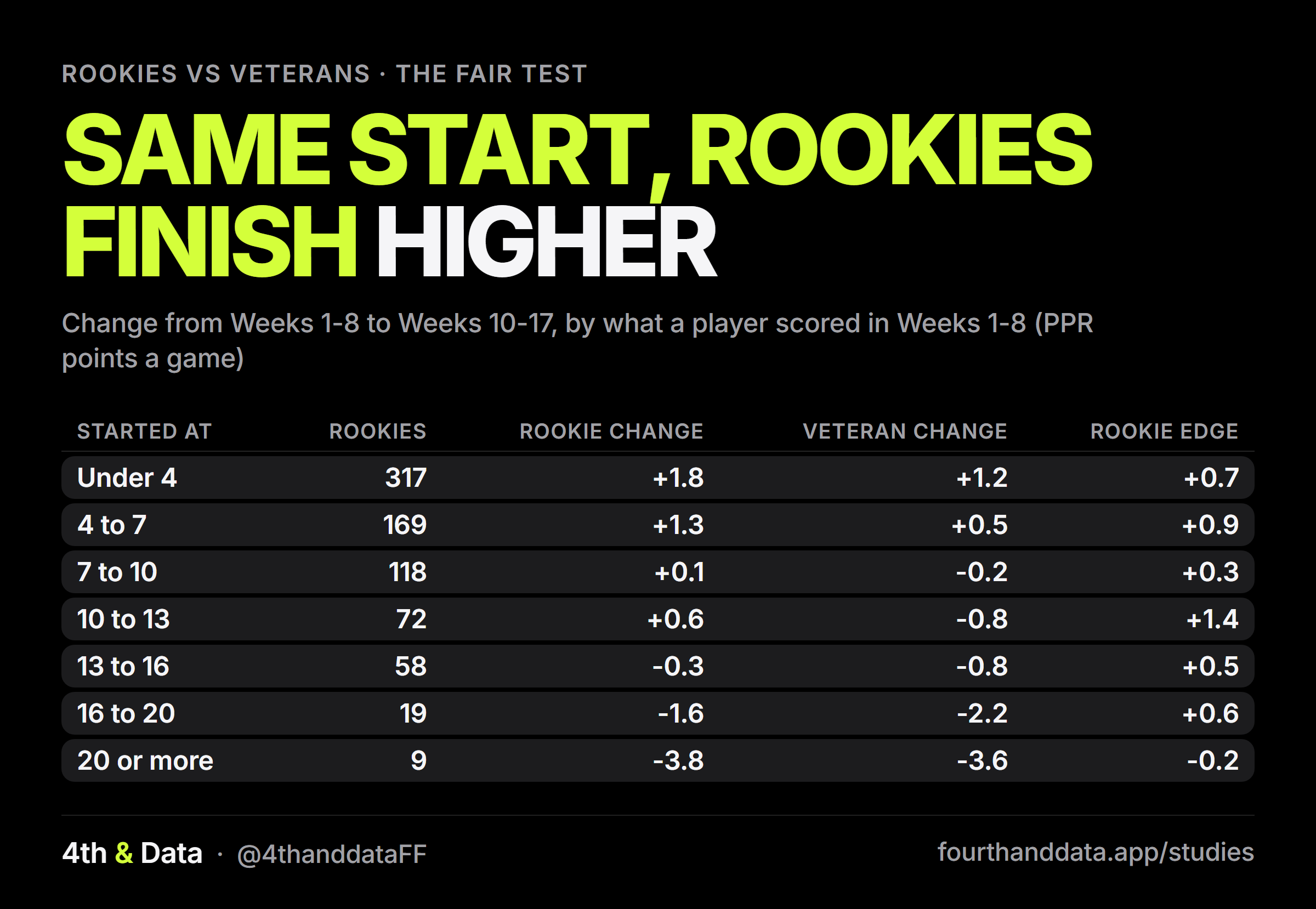
So we compared every rookie only with veterans who started at the same level. Rookies came out ahead at almost every level. Among players who scored 10 to 13 points a game in the first half, rookies gained 0.6 and veterans lost 0.8.
Averaged across every level, rookies gain 0.7 points a game more than matched veterans. The 95% range, where the true number very likely sits, is 0.4 to 1.0, all above zero. The rookie edge is real.
Every season
One season can fool you. So we ran the same matched test on each season by itself.
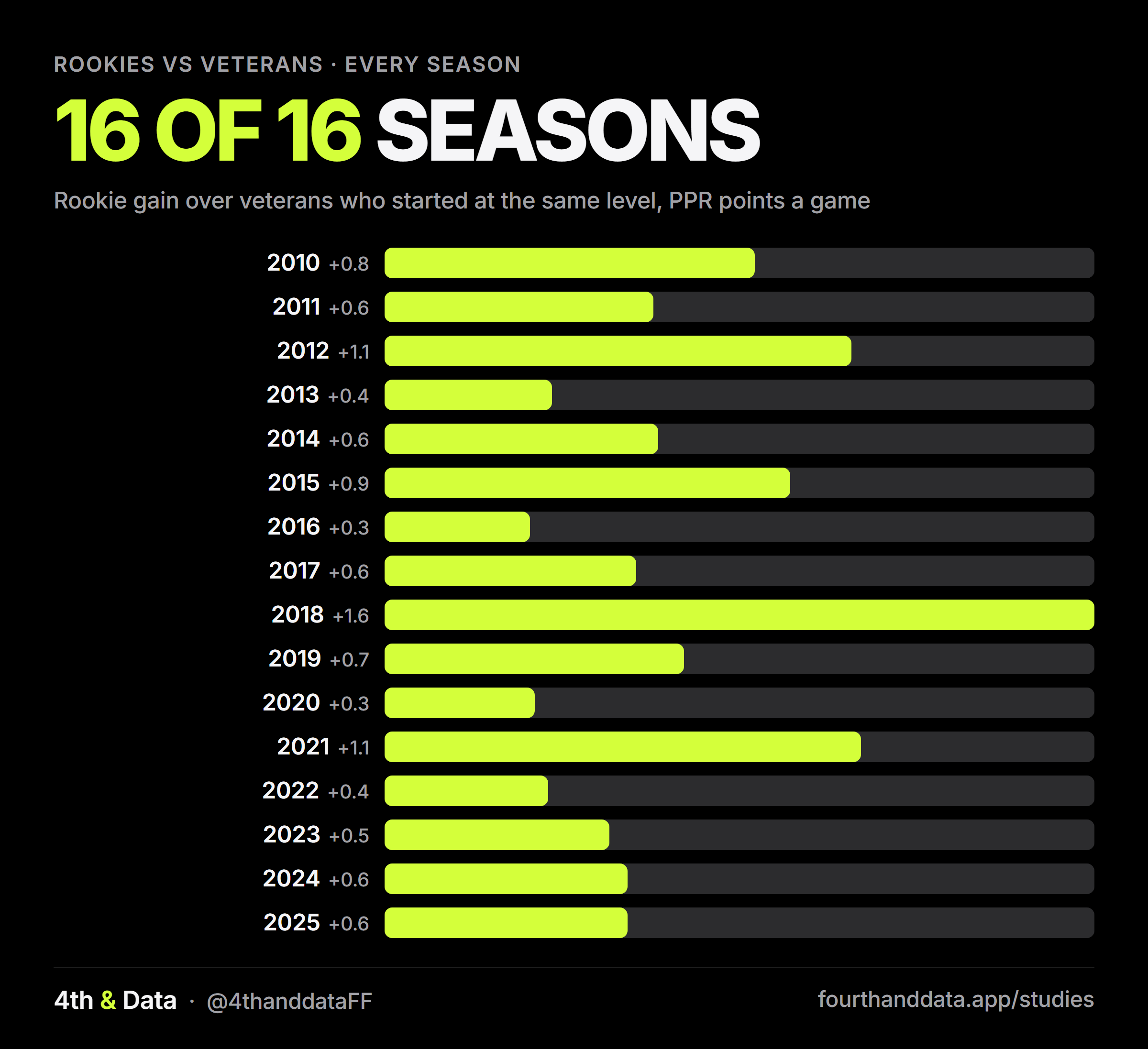
Rookies gained more than matched veterans in all 16 seasons. The smallest edge was +0.3 in 2016, the largest +1.6 in 2018.
All 16 seasons
| Season | Rookie gain over matched veterans |
|---|---|
| 2010 | +0.8 |
| 2011 | +0.6 |
| 2012 | +1.1 |
| 2013 | +0.4 |
| 2014 | +0.6 |
| 2015 | +0.9 |
| 2016 | +0.3 |
| 2017 | +0.6 |
| 2018 | +1.6 |
| 2019 | +0.7 |
| 2020 | +0.3 |
| 2021 | +1.1 |
| 2022 | +0.4 |
| 2023 | +0.5 |
| 2024 | +0.6 |
| 2025 | +0.6 |
It is the role, not luck
Points can come from a fluky touchdown. Usage is harder to fake. So we also checked each player's share of his team's targets and carries. For receivers and tight ends that is targets, passes thrown his way. For running backs it is carries plus targets.
Against matched veterans, rookies' share grew by 1.5 points in the second half, with a 95% range of 1.0 to 2.0. The team gives them more of the work. The points follow the role.
By position
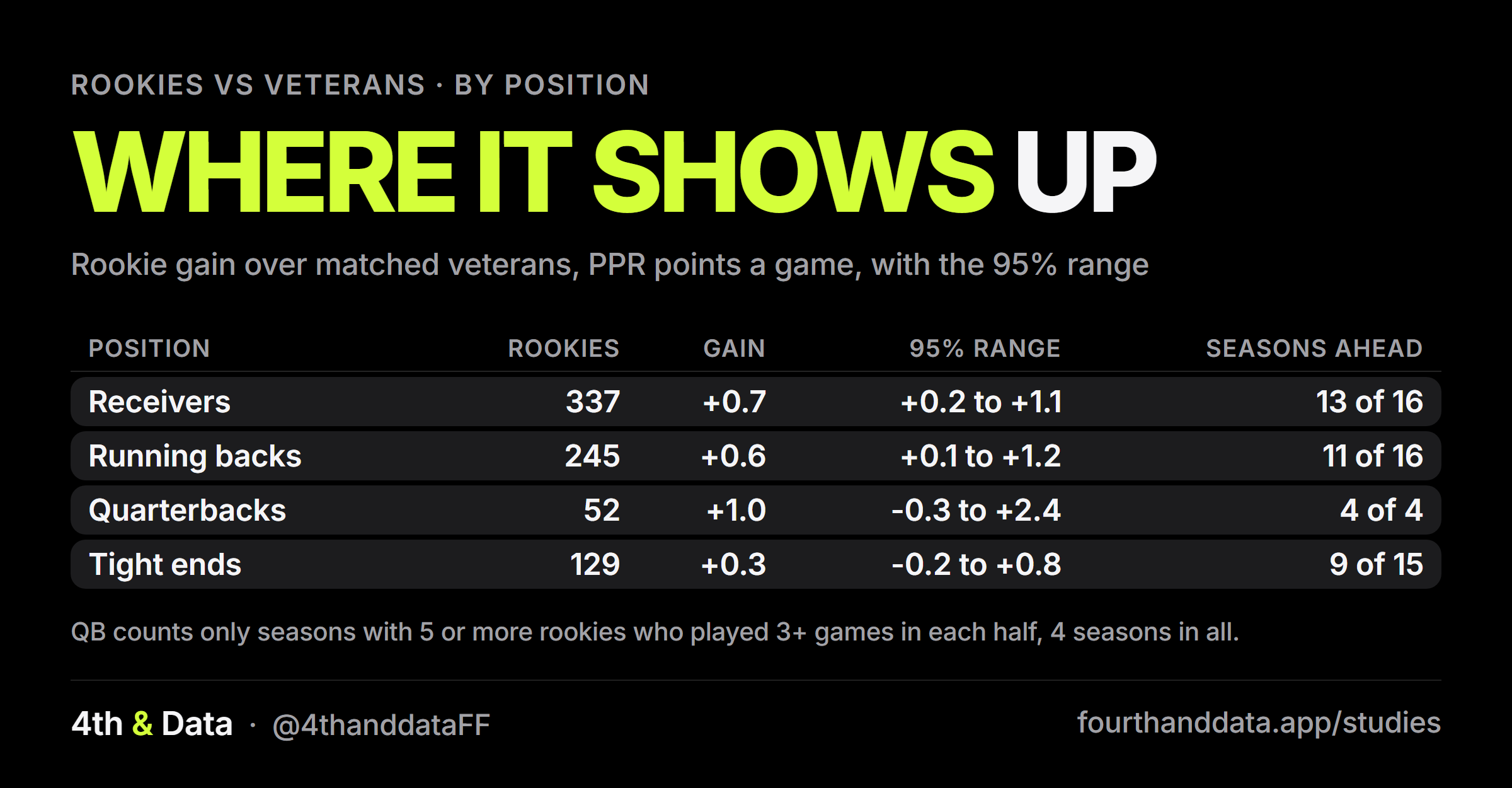
| Position | Rookies | Gain a game | 95% range | Seasons ahead | Share gain, points |
|---|---|---|---|---|---|
| Receivers | 337 | +0.7 | +0.2 to +1.1 | 13 of 16 | +1.3 |
| Running backs | 245 | +0.6 | +0.1 to +1.2 | 11 of 16 | +2.1 |
| Quarterbacks | 52 | +1.0 | -0.3 to +2.4 | 4 of 4 | n/a |
| Tight ends | 129 | +0.3 | -0.2 to +0.8 | 9 of 15 | +0.9 |
Seasons ahead counts seasons with 5 or more rookies at the position. Quarterbacks had that in only 4 seasons.
Receivers show it most clearly, +0.7 a game, ahead of matched veterans in 13 of 16 seasons. Running backs are close behind at +0.6, with the biggest growth in usage share of any position.
Quarterbacks and tight ends are too noisy to call. Their ranges include zero, so we cannot tell their rookies apart from veterans.
The rookies you would actually start
Most rookies in the study barely played fantasy roles. So we looked only at rookies who scored 8 or more points a game in the first half, the ones on your roster. There were 228 of them, and they gained 0.8 points a game more than matched veterans.
Across every rookie since 2021, the biggest jumps were huge. Amon-Ra St. Brown went from 7.7 points a game to 18.4 in 2021. Tank Dell went from 11.7 to 21.7 in 2023. TreVeyon Henderson went from 6.6 to 17.6 last season. Not every rookie does that, but the ones already producing are the ones to bet on.
The 2026 rookies who fit
Through Week 6, these rookies are scoring 8 or more PPR points a game, have played at least 3 games and are not on the injury report.
| Rookie | PPR a game | Games | Rostered |
|---|---|---|---|
| Carnell Tate WR, Tennessee | 11.2 | 6 | 86% |
| Germie Bernard WR, Pittsburgh | 10.6 | 5 | 45% |
Rostered is the share of ESPN leagues. Also at 8 or more but left out: Omar Cooper Jr. (2 games), Denzel Boston (questionable with a foot injury), Jeremiyah Love (questionable with an ankle injury), Caleb Douglas (2 games, questionable with an ankle injury).
Denzel Boston, at 11.9 a game, would top this list. He played through a foot injury in Week 6 and was limited in practice on Wednesday. If he is healthy, he fits.
Both are receivers, the position where the effect is strongest.
The call
A rookie who is already producing is more likely to keep rising than a veteran scoring the same, by about 0.7 points a game over the second half. Start with rookies who already have a role. The data does not say a rookie with no role is about to find one.
If you are choosing between a rookie and a veteran at the same level, lean rookie. Hold Tate and Bernard through the second half.
How we measured
- The sample is every regular-season game from 2010 to 2025 for quarterbacks, running backs, receivers and tight ends, from the nflverse weekly stats. A player-season counts with 3 or more games in Weeks 1 to 8 and 3 or more in Weeks 10 to 17.
- A rookie is a player in the season his record lists as his rookie season.
- Points are PPR fantasy points a game in each half.
- The matched gap compares rookies with veterans who scored about the same in the first half, in seven levels (under 4, 4 to 7, 7 to 10, 10 to 13, 13 to 16, 16 to 20, and 20 or more points a game), then averages the gaps weighted by how many rookies are at each level.
- The 95% range comes from redrawing the player-seasons 2,000 times and recomputing the gap each time.
- Usage share is a player's share of his team's targets (receivers and tight ends) or carries plus targets (running backs), averaged over each half.